Thursday, January 13, 2011

Last-Minute Recollections

So I'm back in Boston, and before classes start up again, I want to mention some of the note-worthy art experiences I had over break.

I took a day trip to New York to go back to MoMA (last time I only had 20 minutes to see the Ab Ex show before I had to catch my bus). SO glad I did! The sheer quantity of paintings in that show is astounding. During our journey through the show, my roommate asked me which was my favorite abstract expressionist, and I must have given her at least five different answers. "Oh man, JOAN MITCHELL, OK, she's my favorite"..."Oh no wait! Sam Francis..." "Mmmmm, DeKooning"...""OH GOD A ROOM OF ROTHKOS!!!! Alright, Rothko might really be my favorite..." And so on for a seemingly endless stretch of rooms. Endless in a good way-- it could have gone on forever, and I still would have been captivated. (The Ab Ex show is up until April 25th, so you have plenty of time to go and be seduced by paint. Just...please don't be a tool and pose obnoxiously in front of the Barnett Newman...we witnessed that happen, and it's the only time I've ever felt really happy about someone being yelled at by the guard)

Also at MoMA that day, we got to see On Line: Drawing Through the Twentieth Century, which incorporated a pleasing array of media. There were many fantastic pieces by many amazing artists (our friend Ms. Schneeman even made an appearance), but the one that stood out most for me was actually the one at the entrance, Just a Bit More by Ranjani Shettar, which consisted of pigmented beeswax balls held together by tea-dyed thread. I got yelled at for trying to take a picture, but here are some photos someone else was allowed to take, brought to you via the interwebs:


I stared and walked around this piece for about 15 minutes (true, I was waiting for my roommate to return from the bathroom, but it was still pretty damn captivating regardless). I started to see the slight variations in color that created a sort of journey for the beeswax balls, which started to feel like matter or water particles, or networks, or webs. I really really wanted to touch it or duck under and stand amongst them. I'm pretty sure I would've gotten more than yelled at if I'd done so though...(You can see On Line through February 7th)

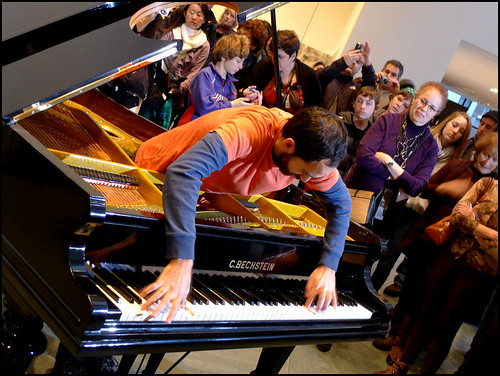
Oh yeah! On our way upstairs to see On Line, we were distracted by the sound of piano music. It turned out to be Stop, Repair, Prepare: Variations on "Ode to Joy" for a Prepared Piano, a performance piece by artist team Allora & Calzadilla in which hired professional pianists stand in a hole cut in the center of a grand piano and play the song upside down and in reverse, while simultaneously roaming around through the crowd of onlookers (the piano is on wheels). It was very funny, and it certainly caught the attention of essentially everyone in the museum. I took a picture of the crowds lining the stairwell balconies, looking down on the performance:


and here's a visual of the actual piano-playing:

On Friday, I went with my Mom to the PMA to see the Michelangelo Pistoletto show, which was a pretty excellent retrospective. My favorites were the mirror paintings that implicate the viewer as a victim/ co-conspirator in the action:
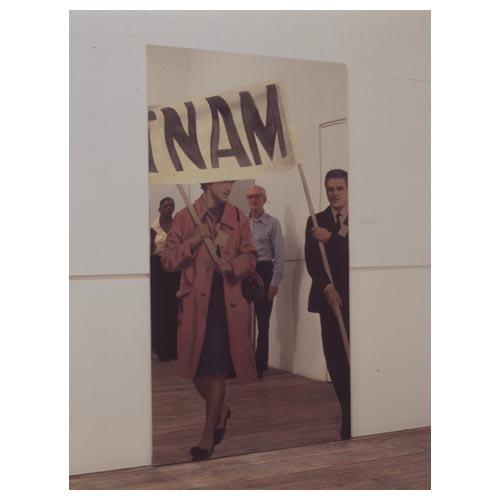
Vietnam

Man Shooting

Noose

Cage

and Orchestra of Rags:


For this piece, tea kettles are surrounded by walls of rags and covered with a layer of Plexiglas. When they go off, their trilling disrupts the space, and the condensation from the steam creates shapes on the Plexiglass. We were lucky we got to see it in action--the guard said they only turn the kettles on twice a day!

There's also an auxiliary installation devoted to Pistoletto's work with Cittadellarte, an organization that he founded in Biella, Italy in 1998, which focuses on projects related to art, economics, education, politics, ecology, and communication, fueled by his belief that "art is at the center of a responsible transformation of society". The separate gallery features his Love Difference Tables, which have traveled to cities all over the world in order to invite discussion and collaboration with various other institutions.


The PMA has been co-sponsoring various events and worshops in conjunction with the exhibition. You can read all about it at the PMA's website. So I guess that kind of makes up for not being allowed to touch Structure for Talking While Standing Up or Lunch Painting...
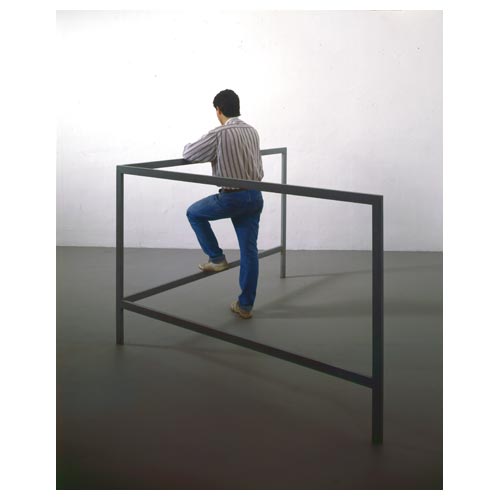
(All things Pistoletto end tomorrow! Go see them NOW!)

Saturday, January 1, 2011

The List, Installment 7: Performance

Happy New Year!

OK, today we're gonna look at some of my favorite artists that can loosely be gathered under the rubric of "performance". As promised, I'm kicking it off with...

Carolee Schneeman:

Meat Joy, 1964


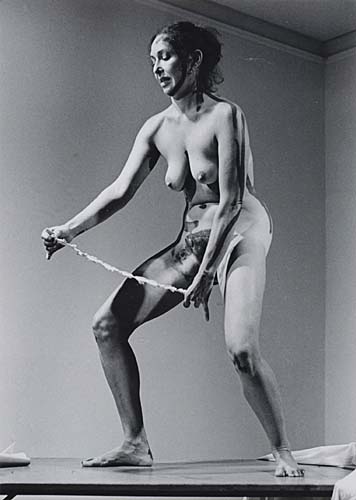
Interior Scroll, 1975

Carolee Scnheeman is a feminist rock star. The woman rolled around in a raw meat orgy and pulled a scroll of text out of her vagina, which she read aloud to an audience. I repeat, rock star.

Marina Abromović:
Rhythm 10, 1973

Imponderabilia, 1977


Rhythm 0, 1974

Anyone lucky enough to have attended "The Artist Is Present" at MoMA last spring knows the incredible scope of Abromovic's thought-provoking work. I unfortunately didn't get to go, but I would so have loved to walk through the reproduction of Imponderabilia (not sure I would've battled the crowds to sit across from her, though having a staring contest with Marina Abromović is certainly among the more awesome potential museum experiences that I can think of). Rhythm 0 is one of her more disturbing pieces. It's strikingly similar to Yoko Ono's Cut Piece (1964), which I talked about in an earlier post, but without the direct command of "cut" (and with the addition of a loaded gun...)

Adrian Piper:

Catalysis Series, 1970/1


My Calling (Cards) #1 & #2, 1986-90

Adrian Piper's work is great because it manages to be witty about the discomfort it causes. For her Catalysis series, she basically just did weird things in public (plugging her mouth with a sock, covering her clothes with wet paint, etc.) to gauge people's reactions to perceived abnormal behavior, or to "the other". Her Calling Cards are particularly great, and pretty self-explanatory. Did I mention she has a Ph.D. in Philosophy?

Joseph Beuys:

I Like America and America Likes Me, 1974

How to Explain Pictures to a Dead Hare, 1965


7000 Oaks, 1982-87

Joseph Beuys is a special idol of mine. I wrote a paper about his work a while back and am just in awe not only of his physical artworks, but of the scope of his ideas. First of all, he has a pretty epic mythological origin story that definitely trumps the vast majority of other "genius" artist cultivations (I'm lookin at you, Matisse...)--his involves being nursed back to health by Tatar tribesmen when his plane was shot down during World War II--according to his account, they wrapped him in animal fat and felt. Subsequently, he created works incorporating alchemical materials, believing that the materials he was healed with could invest his art with the power to heal the world. So clearly I adore him. I Like America and America Likes Me deserves to be explained: In May of 1974, Beuys flew to New York, and was rushed via ambulance to the gallery (wrapped in felt of course) in which he spent 3 days living with a wild coyote. Yeah. When it was over, he was rushed back to the airport via ambulance, thus leaving America without experiencing anything other than his communion with the coyote. Later in his career, he developed the concept of "social sculpture", regarding the whole of society as one great work of art. 7000 Oaks was a project for which Beuys (as the title suggests) planted 7000 Oak trees, accompanied by pillars of basalt, both in Kassel, Germany and in New York (you can still see them on West 22nd St. between 10th and 11th Avenues--they're really beautiful, and the basalt pillars are nice to touch)

These works all incite deep thought, visceral reactions, sometimes even physical interaction/ participation. They reveal significant things about the nature of people and of art. They're not just about the act--they're about the reactions and thoughts the actions provoke. Chills, people, chills.

Thursday, December 30, 2010

The List, Installment 6: Assemblage


Today's installment is gonna get ugly. Visceral, disgusting, ephemeral--I'm talking entropy. I'm talking shit that pushes the boundaries of what constitutes Art. I'll start with someone familiar

Robert Rauschenberg:


Bed, 1955

Charlene, 1954

Monogram. 1955-9

Canyon, 1959

Rauschenberg wasn't afraid to get messy. His combines incorporated found objects, including underwear, bedsheets, and taxidermy animals, giving the paint a bodily, sometimes scatological feel. And this was the 50s, mind you

Bruce Conner:
Couch, 1963

Looking Glass, 1964

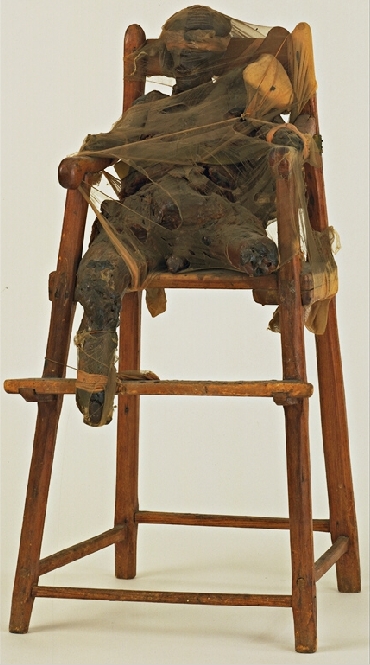
Child, 1959-60

Creepy right? Conner favors nylon stockings, costume jewelry and fur in his pieces. Dark, twisted, disturbing, violent. Check, check, check, check. But look at how the fetishized materials communicate content.

Edward Kienholz:
Roxys, 1961

The Hoerengracht, 1983-88


The Beanery, 1965

The State Hospital, 1966

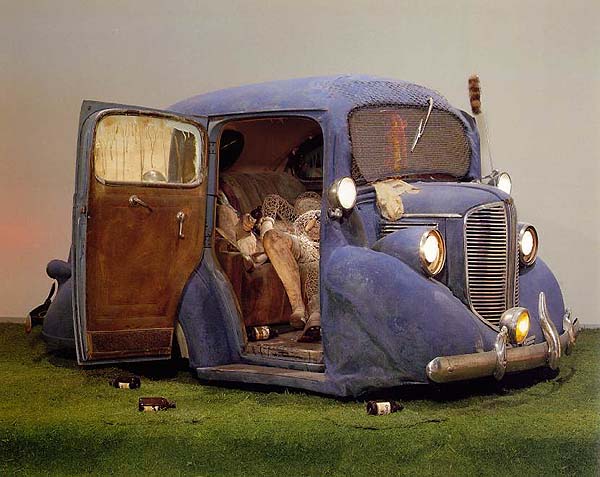
Back Seat Dodge '38, 1964

Kienholz made tableaux depicting macabre representations of bars, brothels, the seedy underpinnings of daily existence. These pieces are unavoidable attacks that expose society's twisted secrets. Plus, resin just makes everything disturbing.

Paul Thek:

Fishman in Excelcis Table, 1971-2

Peter Hujar, Thek Studio Shoot Face of the Tomb Effigy 6, 1967

Untitiled (Hand with Ring), 1967

Meat Sculpture with Butterflies, 1966

Untitled, 1966

I recently saw the Paul Thek show at the Whitney (which is up until Jan 9th, so go see it if you haven't). His meat sculptures are some of the most delightfully revolting things I've ever seen in person. They're made of resin, beads, human hair, among other things, and are encased in plexi boxes. A couple even had big ol' plastic flies accompanying the festering "flesh". They're nauseatingly convincing. In a good way. Thek also made full body casts which he used to create alter egos for himself including the Dead Hippie and Fishman. I stood under the Fishman piece, mentally willing one of the flimsier bits of laytex to fall on me. The curatorial intern said it would have been highly possible.

Wow, there's a lot of testosterone in this post...Next post I'll have to call out Carolee Schneemann to represent...

Tuesday, December 28, 2010

Artistic Anarchy?

Who wants to join me for another late night/early morning thought process?

Great. So here's what's swirling around in my head:

I've been thinking about how works of art can engage people (you know this already). But I had an idea: what if the Artwork (as in the physical object) is not the complete Work of Art. Bear with me here. The painting, rather than being the whole shebang of the Art being presented could instead function as the stimulus for a larger experience that encompasses the Art being presented. Here's a specific example that's been marinating for a while:

What if you encountered an enormous canvas covered in tactile layers of paint, and you were actually allowed to touch it?? Yeah, think about that...Rather than the Painting being the Art Object that you're supposed to contemplate and revere, your interaction with that object becomes something more--an Art Experience. Think about the implications of this process--as people touch the surface of the painting, they will slowly change its presentation by eroding away at the layers. And the most tactile spots, the places that people feel most compelled to touch, will wear away the fastest. The painting will eventually wear away completely and die, but everyone who had the chance to touch it will carry that experience with them for the rest of their life! The painting, in this way, sort of becomes human (in that it dies and lives on through the memories of others).

Or, what if you could be inside a painting, or at least have the sense that you were. This is a really new idea, so I haven't come up with more details as far as the execution (something about building layers that you could pass through visually or physically), but these are the sorts of concepts I'm kicking around.

Anyway, the most important part of these ideas for me is the concept of the painting as a stimulus rather than an end product. There is a whole discourse surrounding work that functions as a void upon which the viewer can project an idea (I'm thinking of Rauschenberg's white paintings, or even Lygia Clark's Arquitecturas Biológicas, which she deemed "completely void of meaning and with no possibility of regaining life except by human support”). But I'm not even talking about the void here. I'm talking about work that functions as the impetus for a larger experience that becomes the Work of Art (maybe a better example would be Edward Keinholz' The Beanery, but even that piece had a clearly defined divide between viewer and object). The point is, I'd rather create objects that incite lasting experiences with the proviso that they won't last forever than create pristine fetish objects that incite nothing but the same tired old viewing processes for centuries. I feel like breaking down the barriers of acceptable behavior is paramount to making something that will last in a real way that isn't just about a surface, image, or object. The potential for interaction--that's the key difference.

I guess we'll see how my upcoming paintings manifest given all of this...I'm definitely gonna try to make the Touchable Paintings, at the very least.