Tuesday, December 7, 2010

The List, Installment 5: Installation

My internal dialogue last night got me thinking about all of the installation art that most inspired me, so I've decided I should devote a post to installation work. These are things I've actually seen, so the bulk of the images are going to be pictures I took (I apologize in advance if the quality is sub-par)

Nadya Volicer's Brain Storm at DeCordova, Lincoln, MA:

Here's the blurb about the project from DeCordova's website:

"
We asked four artists to create proposals for installations that were suitable for families, and would thus address safety issues, appeal, and age-appropriateness. It was required that the installation be interactive and additionally feature an educational component which would enable families to learn about the artist, installation, and key concepts together. After reviewing the proposals and interviewing the artists, we selected Nadya Volicer's proposal for an installation called Brain Storm.

"Brain Storm" is an immersive environment inspired by, and suggestive of, the creative process. Using nature as a metaphor, this work asks the viewer to step into the moment of inspiration. Entering this installation is like walking into the middle of an idea just before it sweeps you off your feet. Various stages of creativity are intimated in the solidity of the central tree, the rings of history in the truncated, moveable stumps, the excited flurry of the whirlpool circling the room, the waves of grass pushing up through the ground. In this work, the process of art-making mirrors the regenerating growth of nature, from seed to leaf to seed. This posits art-making as a continuous practice of one idea germinating the next, on an individual basis, and throughout the history of art.
-Nadya Volicer"


In order to enter the space, you have to take off your shoes, which immediately sets the mood for a childhood experience (I mean, the room is intended to engage families, but I think everybody can benefit from acting like a kid every once in a while). Upon entering the room, you realize that the floor is covered in swatches of fabric with varying colors and textures, which you can actually feel because you're barefoot!

Everything in the room is made from reused/ recycled materials

The leaves and birds are handmade paper

There's a pamphlet that provides directions on how to make your own

The tree stumps are made of jigsaw wood swatches and old magazines

And the areas around the trees that are made to look like fallen leaves are actually knotted rags (which provide yet another texture for your toes to explore)

Perhaps best of all, there are books! You can sit on the floor or on a stump and select from such classics as Oh the Places You'll Go and The Giving Tree (I chose the latter)


Material World: Sculpture to Environment at Mass MoCA, North Adams, MA:

From their website:

"Working in a range of modest, industrially produced materials -- from plastic sheeting to fishing line -- Michael Beutler, Orly Genger, Tobias Putrih, Alyson Shotz, Dan Steinhilber, and collaborators Wade Kavanaugh and Stephen B. Nguyen engage the former factory spaces of our second and third floors, creating extraordinary environments from ordinary things."

I'll walk you through the installations as I encountered them (focusing on my favorites), starting with Tobias Pruith's Re-projection:

Using only a spotlight and monofilament, Pruith created a mesmerizing space to encounter

You could stand inside the arc created by the string, surrounded by visible light...

As you moved closer to the wall, the space got smaller

Next is Wade Kavenaugh and Stephen B. Nguyen's White Stag:

Guess what these creeping biomorphic structures are made of. That's right, paper! They were so amazing and associative. Like cartilage trees...

or tentacles

or alien plant tendrils

or dinosaur bones

or bodily caverns

or stalactites

They also shared space with Orly Genger's Big Boss:

Genger used 100 miles of industrial rope to create this monumental, hulking mass of material

It's like it broke through the wall


It functioned like lava


or a waterfall

Alyson Shotz' The Geometry of Light related well to Pruith's piece from earlier:
It combined plastic discs with glass beads to make an elegant, sweeping form

I loved the way the shadows activated the floor and wall space


It was like enormous jewelry made of water

In the next room was Eli Levenstein's Reading Room:
(This is the installation I referred to in the VTS post)
Every inch of the space was activated! The lights were strung on multicolored wires.

The windows were covered in intricate, crispy layers of paper clips and bubble wrap

so cool!!


There were cushions made of more bubble wrap and colorful rubber bands/ string

and, of course, there were books

Look at the difference between the adults and the kids. Adults...

Kids

This may be the most illustrative photo...

The walls had more bright string and shiny nails


which pointed the way to this gorgeous staircase, which took you to...
More of White Stag!!!

This was a much brighter space, so the mood of them was less prehistoric, and more exploratory

Yet another example of kids showing everybody how it's done

The paper started to feel like feathers


This was taken standing inside one of the large cavernous flutes. It made me think of lungs

Look at that fluid movement!

I'll stop here because the Mass MoCA exhibit kind of counts as 5 installations, which makes this a pretty long post. But my point is, this is how you engage people!

Monday, December 6, 2010

Re-Orientation

I had a really great crit today with Francesca DiMattio. She brought up a lot of the things that I've been struggling with/ trying to work out, which has put me in this post-crit mental state that's causing me to question everything I'm doing. Stressful, yes, but it's also a really great place to be because it allows me to re-assess the things I've been making in terms of what I actually want to be making. So, in the interest of re-orienting, I'm coming up with a "list" (for lack of a better term) of what I ideally want my artwork to be doing/ considerations that I think my art could benefit from. I'm gonna post it here just to remind myself:

1. Okay so, the frustration spiral is stemming from the fact that I need to focus more on making deliberate decisions/ committing to an intention. To a certain extent, I can allow the materials I'm using to dictate what kinds of decisions need to be made, but it becomes really complicated really quickly. I start asking myself questions like: Does something necessarily need to be a painting? What is the difference between a painting and a drawing--more specifically, how does something look/feel/act as a drawing that is different from the way that thing would look/feel/act as a painting, or even as a sculpture? Which context/ material is going to suit the intention best? Is there a way for everything to converge in a way that makes sense and serves the idea? Which then descends into the really awful territory of: What is my intention in the first place? What am I even trying to say?

2. Well, my main concern lately is providing an experience which activates/ engages/ empowers the audience. I don't know necessarily how best to do this yet...I do know that I don't want to be creating static/ safe pieces--I want the things I make to have some sort of impact beyond the aesthetic. I want there to be a certain amount of intensity involved. It could be as simple as presentation or scale, and it could be as drastic as completely altering the kinds of objects/ images I'm making. Or deciding if making objects/ images is even the best way to go--maybe I should be thinking in terms of installation works or performance even (think Yoko Ono's Cut Piece):


3. I'm increasingly trying to get away from the constraints of traditional dynamics. If we're sticking with images, this could involve moving away from the square, or exploring nontraditional media (I'm thinking cardboard or other gritty ephemeral materials), or figuring out a way to push the boundaries of the materials I've been using (which I kind of started to do with paint before I got distracted by this attempt to translate my paper cutting sensibility). But really, there are conceivably no limits to how far I could go.

4. I want to allow whatever materials I'm using to express themselves, which means embracing the particular character/ potential of individual media, while simultaneously infusing life/ energy/ purpose. Right now, I love wood because of the way it lends itself to building and constructing forms; paper is most engaging for me through a process of intricate cutting and layering; painting functions best when it presents in a crusting, oozing, slippery, dripping kind of mark that can simultaneously create form and atmosphere. Layering, building and composing are essential for all of these.

So that's kind of where I am right now. Still a really tumultuous place. We'll see what comes of it...

Thursday, December 2, 2010

VTS

I've been thinking a lot about the institutionalization of art. I feel like there's this disconnect between the way art is presented and the engagement that art institutions purport to promote. A lot of the people I've spoken to who say they don't like art or don't enjoy visiting museums often feel polarized by Art or by Art Institutions. When they enter an exhibition and are confronted with a sea of information that they're supposed to already know in order to understand what they're looking at, it automatically sets off this defensive thought process that inhibits them from having any sort of real connection with the work. There's this inherent dichotomy in art presentation that places the Art Object on an unknowable pedestal. Essentially, visitors are told, "This is Art--you cannot know it; you cannot touch it; as a non-artist, the closest connection you can hope to have to this object is through reverence or ownership." That is so not what art is really about! There has to be some way to engage people with work that doesn't end up making them feel insecure, invalid, or insufficient.

Well, today I participated in a VTS (Visual Thinking Strategies) session, and it was completely revelatory. Basically, the facilitator chooses a work of art and waits for the group of viewers to start discussing the work. The facilitator's job is to validate and reiterate the thoughts expressed by the viewer and encourage deeper thinking. For example, if someone says, "This makes me think of winter," the facilitator would respond, "what do you see here that makes you say that?" It's like a physically acted out formal analysis, and it is one of the most empowering things I've ever experienced. It makes the viewer realize that they have things to say about a work of art, and not only that, but that the things they have to say are completely valid! Rather than pragmatically imposing a set of defined meanings on an audience, VTS allows viewers to interpret pieces in a way that allows them to build their own meaning, and more often than not, the meanings they intuit are spot on. Works of art speak for themselves; they speak to people; they engage people in thought processes that they haven't necessarily considered before. That's the entire point of their creation, and that is exactly the kind of experience that people want to open themselves up to. But when the viewer is made to feel right off the bat like they're imposing, or like they inherently don't belong because they never got an MFA, that wonderful, fulfilling relationship is cut off before it can even start.

Every artist's mission is different, but I think it's safe to say that we all hope the things we create will mean something to someone. We want people to connect with our work--that's one of the main reasons we create things in the first place. The majority of the artists I've spoken to or have heard speak have some anecdote about how the greatest critique they ever received came from a child who innately understood how to interact with their artwork without being inhibited by social convention. Kids have a way of interacting with the world that is still about building connections rather than maintaining differences. I saw an installation at Mass MoCA last spring that perfectly illustrated this point: it was a room full of cushions and books, with shiny staples and multicolored wire creeping over the floor and up the walls. Adults walking in felt compelled to appreciate the environment at a distance, taking in the aesthetic choices the artist had made, making judgments; their kids on the other hand dove onto the cushions, picked up the books and started reading. They ran their fingers over the variously textured fabrics, rolled around on the carpeted floor. They totally got the point, and their parents couldn't even see it! It's because their parents have been systematically conditioned to engage with art in a certain way--stand at a distance, appreciate, don't touch, move on. You get yelled at if you do anything else--an alarm might even be set off if you get too close. But the only way you can truly hope to engage with/ understand a work of art is by getting right up close to it to see how it's made (the Process Gallery at the DeCordova Museum in Lincoln, MA provides a fantastic experience that breaks down that barrier and actually invites visitors to see how the art they just viewed was produced: http://www.decordova.org/art/processgallery/aec.html). If you haven't gone to art school, you haven't had a professor tell you that, so you assume the museum personnel know what they're talking about and have your best interests in mind. But they don't--they're concerned with keeping the Art safe from whatever harm you might inflict on it. Yes, they want to educate you, and ideally they want you to leave having had a profound experience with a work of art...just as long as you didn't get too close.

My point is that there is something profoundly wrong about this setup. People are clearly capable of having brilliant moments of clarity and connection, and they should be encouraged to have those moments with art most especially. When conservation is the primary concern, those moments of profundity are tabled in the name of some warped systemic interplay, and that's not right. Yes, artists want to live on through their work, and keeping the objects they created in pristine condition for as long as possible helps achieve that, but if the preservation of those objects prevents people from having an experience, then there's no real point in preserving the object in the first place because its purpose is no longer being realized. Art objects are meant to be engaged with; people want to engage with works of art. It's only when some constructed thing gets in the way that those facts fail to coalesce into a memorable experience...Or the art might just be bad, which is another issue entirely...

The Show!

The senior studio exhibition was last night, and it was fantastic! We brought all of the work over on Monday, spent all day Tuesday (and some of Wednesday) installing, and then had a lovely time basking in the glowing praise from our friends/ family/ colleagues (the free wine was definitely a key player in the glow).

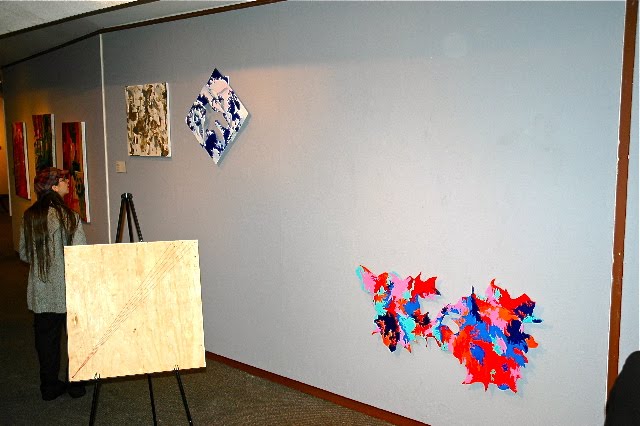
As promised, here are some installation shots:

My ultra-fancy wall label

Look at all the people!

All of the better quality photos were taken by my Uncle Rick, who came to the opening and reads this blog. Thanks Uncle Rick!


Various people throughout the evening asked me about the arrangement of my work on the wall, which made me really happy because the whole point was to get them to look and consider the work beyond the straightforward "oh, huh, this is what this student made this semester" line of thinking. I wanted the placement to act as a compositional element that elaborated upon the movement within the pieces. I felt like arranging them this way just suited them better than a straightforward 1,2,3 kind of presentation because the pieces themselves are pretty nontraditional. I was also extremely pleased by the fact that the wall I got was gray and not white.


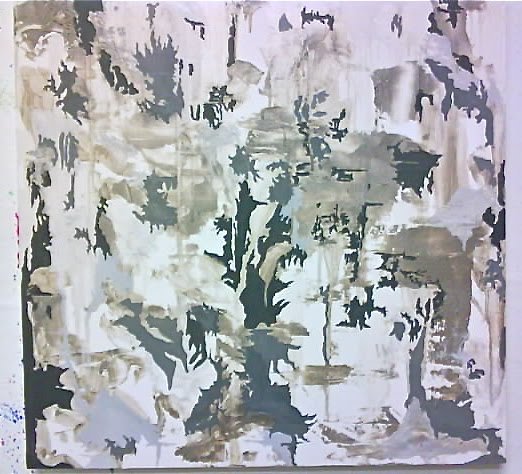
And because this is new work, I'll include some closer shots so you can maybe see the some of the more minute details:

You might not really be able to see it, but this was painted using an iridescent silver oil stick, so the surface shimmers. People liked this one a lot.

This is one of the wood relief pieces that weren't ready to be posted earlier. I attached the pieces of wood in a way that allowed for spacial depth and shadows. There are hints of pink in it that you can't really see here. I didn't paint it as a diamond, but chose to hang it that way for the show (part of the mission to make everything dynamic. I think it worked).

This one's just difficult to portray accurately. Like the other relief piece, it's made of a bunch of adhered pieces of plywood that I cut out on a band saw, so there is dimension to it (which is sort of apparent from the shadows), though these pieces were adhered directly, so it's flatter. Additionally, there are the interior shapes that augment the harder lines of the original wood cutout shapes. And some of the color variations are more subtle, like in that lower right orange area (there are two distinct shades of orange happening in there). Anyway, people seemed to connect with it, and that's all that really matters.

So there you have it! Even though the semester's pretty much over, I'm still going to be working in my studio for a few more weeks, and then next semester will start and I'll have even more things to share. I'm making a book out of a series of monoprints, and I'm still expecting wood to make some large stretchers. We'll see what happens!